Reborn to Die... Another Way!
Chapter 12 — Soft Clay
The morning began with Alex waking up to the steady, heavy breathing of the ox behind him. The woolen shirt Ilsa had shoved his way yesterday prickled his neck and shoulders, but it held the heat so reliably that he didn't want to pull his body out of the straw. The smell of smoke and dried herbs still clung to the fabric, reminding him of the woman's nod yesterday and the corner behind the animal where the draft couldn't reach. Alex sat up, winced at his aching back, and ran a palm over his chest, where the shirt hung like a sack. A familiar irony flashed through his mind: Great. Now I'm officially in the "peaceful village arc" phase. The protagonist has secured a warm corner and even got spare clothes from a local auntie. All that's left is to figure out how this fragile idyll ends. The thought felt light, almost funny, but beneath it lay yesterday's realization—he didn't want to lose this place. Not because it was beautiful or heroic. Simply because it existed.
He stood up, brushed the straw off his trousers, and walked out into the yard. No one grabbed him by the shoulder or pointed a finger toward the gap. They simply passed by and nodded. It was strangely pleasant—as if yesterday's work at the woodpile and the stones had finally moved him from the category of "suspicious vagabond" to "someone who just works." Alex stretched his shoulders, feeling his muscles respond with a tired warmth, and headed toward the well. The air was heavy and damp. The usual morning clamor—the creak of carts, shouts, laughter—was absent. People moved quickly, speaking in short bursts, almost in whispers. Faces were tense, glances clinging to the wooden section in the gap. Alex felt the light warmth from yesterday in his chest begin to mix with something else—a feeling that this silence was a bad omen.
Bram and Kael were already at the well. Both looked as if they hadn't slept all night. Bram was frowning, examining the base of the wooden section; Kael was crouching, running his fingers over the ground. Alex stepped closer—and immediately smelled it. A heavy, sour scent, like a wet dog mixed with rotting leaves and something else that made his throat itch. The ground by the gap had been torn up, as if dozens of paws had trampled it. Kael ran his hand along the lower logs of the wooden section and pointed to deep, jagged scratches—claw marks, with tufts of fur snagged in the wood. Bram caught Alex's gaze, waved a hand toward the forest, then sharply drew a palm across his throat and slapped the base of the section. The gesture was clear: the creatures had come during the night. The wooden section had held, but barely. Alex stood there, inhaling that heavy scent, and felt any romantic notions of survival crumble. There was no epic here, no heroism—only the stench of fear, wet fur, and mud.
Heavy footsteps sounded from behind. Holger approached unhurriedly, but his gait no longer possessed yesterday's relaxation. The Village Elder stopped beside them, surveyed the scratches, and grunted something to the guards who followed with their clubs. One of them pointed to the upper logs of the wooden section, gesturing as if he wanted to prop them up with something thicker. The second nodded. Alex stood slightly to the side, wrinkling his nose at the intensifying smell. Everyone was looking at the claw marks in front, at how the creatures had apparently tried to break through the wood. But he lowered his gaze—to his feet. The clay here wasn't just torn up. It was washed out. He remembered how he used to carry the yoke from the well: water would splash, flow down the slope, and turn the soft loam into a slippery, yielding mush. The creatures weren't ramming the wall with their chests. They were tunneling from below, gnawing at the roots, bracing themselves with their paws, leaving those scratches as marks of their effort. If they reinforced the top but the bottom collapsed, the section would simply tip over in a single night.
His heart beat faster. Alex realized that if he said nothing—or showed nothing—this yard, these people, yesterday's log from Bram, and the warm corner behind the ox could vanish by morning. He stepped forward, feeling his palms grow damp. Language was still useless, but he couldn't back down. Alex made a sound to attract attention, then sharply pointed to the soft, wet clay at the base. Everyone turned. He pointed to the gap, then crouched and began to frantically mime digging—his fingers moving in the air as if burrowing a tunnel under the logs, then he spread his arms, showing how the earth gives way and the entire structure collapses downward. The gestures were abrupt, almost comical. Bram frowned and took a step back, clearly deciding that the stranger had finally lost his mind from fear. The guards exchanged looks. One even smirked. Alex continued waving his arms, feeling his own helplessness and the absurdity of these gestures in the face of a real threat and incomprehending stares.
Holger abruptly raised his hand, stopping everyone. A heavy silence hung in the air, with only the wind rustling in the treetops beyond the wall. The Elder wasn't looking at Alex—he was looking at the ground. Alex froze in his "digging" pose, feeling the total absurdity of it, but he didn't lower his eyes. Despite his age and clearly aching joints, Holger slowly dropped to one knee right in the mud. His boot pressed into the washed-out patch with force. A piece of turf, roots and all, treacherously slid down, exposing the thin lower beams of the wooden section—gnawed through, hanging by a thread, with wet tooth marks. Holger rose slowly and brushed off his hands. His gaze had changed. It no longer held that slight pity for the "poor orphan in a holey shirt." The Elder looked directly at Alex, gave a short, sharp nod—once—and pointed first at him, then at the gap. Then he barked a few sharp words to Bram. The tone was commanding, without unnecessary warmth, but also without suspicion. Bram blinked, his expression shifting. He immediately began reorganizing the people: instead of hauling heavy logs to the top, they grabbed wedges and stones and began driving them into the washed-out trench, tamping down the earth.
Alex exhaled, feeling the tension in his shoulders release slightly. He had been heard. No one patted him on the back or spoke grand words. They simply changed the plan. It was an acknowledgment—quiet, practical, the kind that was valued here. Bram gave him a passing slap on the shoulder—not hard, but noticeable—and shoved another stone into his hands. The work surged forward.
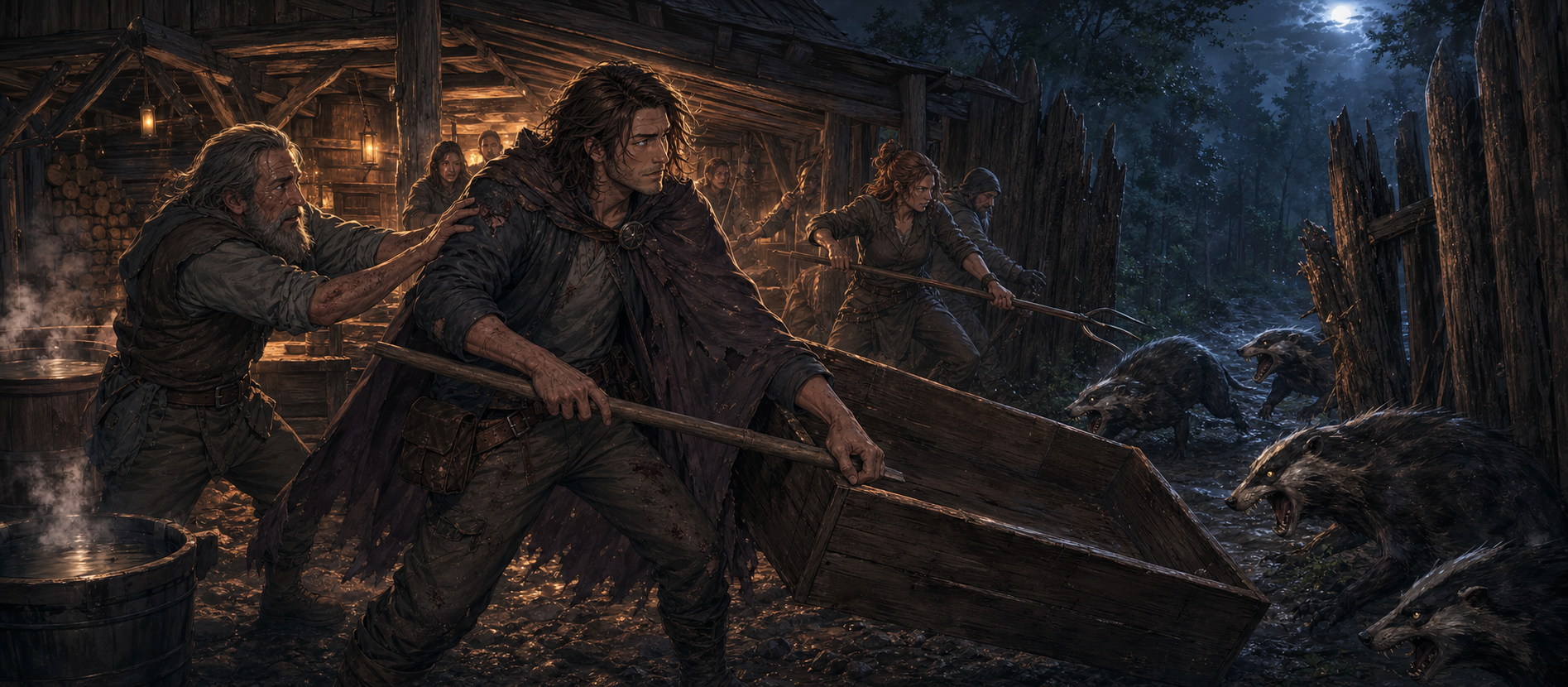
The preparations for the night began without any grand speeches or the distribution of magical weapons. It was simply the feverish, almost comical bustle of adults who knew the night would be long. Someone sharpened ordinary agricultural pitchforks, the screech of metal on stone echoing through the yard. Others hauled stones, muttering short phrases under their breath. Water mixed with ash and fat boiled in huge vats—it smelled acrid, and the steam made their eyes water. Alex received neither a pitchfork nor a club. Apparently, they decided that given his past, what he had was enough. Ilsa approached silently and shoved a heavy wooden tub of boiling water into his hands. The wood immediately scorched his fingers; steam hit his face. She pointed to the narrow breach in the wooden section—the very one they hadn't finished filling with stones—and made a gesture: pour it on any shadow that tries to climb in. The task was dirty, simple, and very specific. Alex gripped the tub with both hands, feeling the heat pass through the wood and burn his palms. He didn't let go. This wasn't "hero's trust," but "you're one of us—get to work." And because of that, he felt simultaneously terrified and strangely warm inside.
Night descended upon the settlement like a heavy, damp shroud. Torches burned unevenly, casting long shadows on the wooden section. Alex stood by the breach, wrapped in his woolen shirt, which now seemed to him not just clothing, but his only protection. His hands trembled, gripping the edges of the tub—the water no longer scorched, but the wooden tub still held the heat. Cold sweat ran down his back despite the shirt. He looked at his fingers—calloused, red from burns—and understood with a sudden, sticky clarity: another death now meant more than just a restart in a new world. It meant the loss of this yard, these nods, the smell of smoke beyond the wall, the log from Bram, and the warm corner behind the ox. He no longer wanted to wake up somewhere else. He needed the night to end here, with these people: with the gestures, the work, the "Vedr" at the well, and the silent approval.
From the darkness of the forest, where the torchlight ended, came the first sound—not a roar, but a quiet, guttural scraping of claws on stone and heavy, wet sniffing. Alex froze, peering into the dark. From the bushes, dozens of reflecting pairs of eyes looked back at him—yellow, hungry, too close. The wind brought the heavy scent of wet dog, and Alex gripped the tub tighter. Now his fragile right to stay depended not on the mercy of the village elder, but on whether this wooden section would hold until dawn. He was ready to fight for it—even if it was with boiling water from a wooden tub.