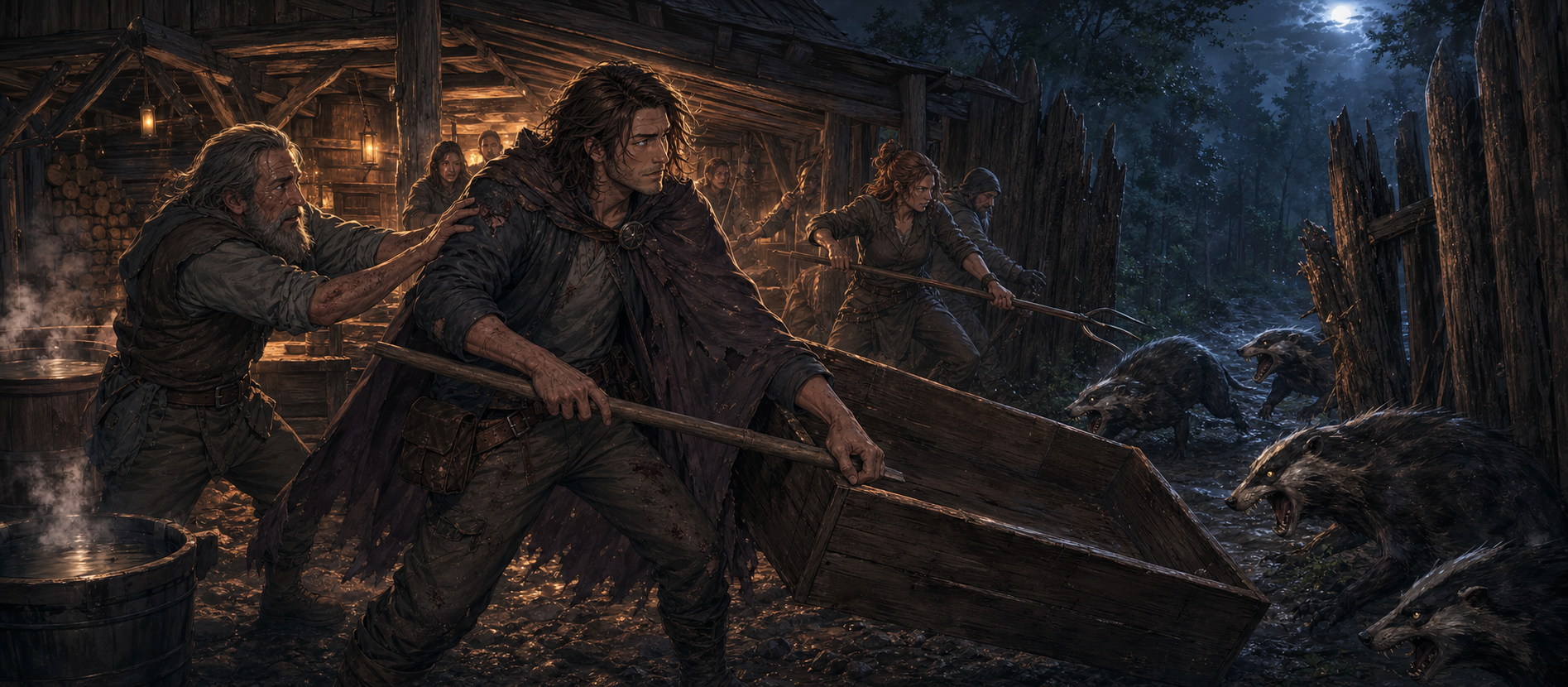
Reborn to Die... Another Way!
Chapter 11 — Vedr, the Woodpile, and a Quiet Anchor
Morning in the barn greeted him with the humid warmth of straw, the heavy stench of manure, and yesterday's sweat. Alex shifted on the hard bedding—his body ached as if he had been put through an industrial mixer. His back muscles pulled, and the linen bandage on his shoulder itched as if nettles had been sewn into the fabric. He sat up, wincing, and his back popped with a dry crack. Gray morning light filtered through the gaps in the walls, casting stripes across the floor. His long chestnut hair was tangled, clinging to his temples from the nighttime humidity.
His gaze fell on his shirt. The alien stains and the neat mark from the stiletto still betrayed him as someone not from here. Alex snorted, adjusting the collar to hide the hole beneath a fold. The fabric only stretched tighter, putting the marks on display. He ran his fingers along the edge of the opening, remembering how it had happened, and sighed. It was impossible to hide his origin and vulnerability—the shirt spoke more eloquently than any words. Instead, there were the looks—they no longer drove him away, but they were still weighing him. He was still a stranger on the sidelines, but he was no longer being cast out. That in itself was a strange achievement.
Alex stood up and brushed the straw from his trousers and hair. His worn shoes creaked on the packed earth. The air outside was fresh, almost biting, with a hint of smoke from distant hearths. The well was already humming with voices; someone was turning the windlass. Glances slid over him from the stable and the woodpile: assessing, but without yesterday's sharp suspicion. He moved toward them, feeling yesterday's linen bandage chafe his shoulder under the strap.
Kael stood by the well, methodically turning the creaking wheel. The bucket rose slowly, water splashing over the edge, cold droplets falling onto the stone. The smell of damp earth and fresh wood from the windlass mixed with the slight acidity of sweat. Alex approached, not knowing how to offer help without looking completely lost. He made a low, drawn-out sound, pointed to the bucket, then to the water, and then mimicked scooping with his hands, as if trying to catch an invisible fish in the air. His fingers moved awkwardly, the calluses on his palms burning with every motion.
Kael stopped and looked at him the way one looks at a calf seeing its own reflection in a puddle for the first time. Kind, but with a touch of pity. The boy narrowed his eyes, a shadow of a smile flickering across his face. Alex recalled all the stories where the hero simply opens his mouth and perfect local speech with the right accent pours out. Reality proved to be far more prosaic. He grunted louder, waved his arms more energetically, nearly hitting the handle of the windlass. The bucket swayed, splashing water onto his trouser leg—cold, like a sudden shower in a cramped apartment after a long day.
Kael sighed, set the bucket on the edge of the well with a dull thud, took Alex's palms in his own calloused hands, and placed them on the windlass exactly as they should be. The wood was rough and cool under his fingers. Then he spoke slowly and clearly, as if addressing someone hard of hearing:
— Vedr.
Alex nodded like a parrot that had finally been taught the right word. His heart beat a little faster from this tiny, almost ridiculous victory. He repeated it, carefully copying the sound:
— Vedr.
Kael grunted—shortly, almost approvingly—and stepped aside. Alex turned the windlass, feeling his muscles stretch and the rope slide over the wood. The water rose, heavy and cold. He smiled with the corner of his mouth. The first victory over the language barrier. It was small, funny, and for some reason, it warmed him more than yesterday's linen bandage under the strap.
The break came suddenly, once the sun had risen higher. Bram simply sat down beside him on a log by the woodpile, handed him a leather flask, and asked nothing. The leather of the flask was warm from his hands, smelling faintly of water and wood. Alex tensed, expecting at least a gesture toward his shirt. Instead, the boy silently took the edge of his shirt, unfolded the fabric carefully, without any roughness, and closely examined the tread marks and the clean puncture. Alex froze, his heart pounding. Dust from the firewood settled on his hair; the sun warmed the back of his neck.
Bram ran a calloused finger over the tread mark on the fabric, which he obviously didn't understand, but he clearly felt its unnatural relief—an alien pattern in a world of wood and stone. His finger lingered, as if testing it by touch. Then he pointed to the hole, mimicked a short punch in the air, and raised an eyebrow questioningly: "Many enemies?" The teenager's eyes were calm, devoid of fear—just the curiosity of a person who had seen a fair share himself.
Alex swallowed, nodded, and spread his arms—as if to say, it happens. The gesture was awkward but sincere. Bram snorted, short and masculine, slapped him on the shoulder so hard his teeth clicked, and pushed the flask toward him. The water was cool, with a slight metallic aftertaste. Everyone in this world had scars. Now he did too. Bram stood up, brushed off his hands, and returned to work, leaving the flask at Alex's feet.
After lunch—meager but honest, consisting of a piece of bread and stewed turnip that finally warmed his stomach—it was the woodpile's turn. His back was already aching, his muscles were burning, and his palms trembled from the unfamiliar load. Alex recalled a corporate training on the correct way to lift heavy objects and began carrying the logs, squatting with a straight back. His legs bent, his knees popped, and he held the logs at waist level—from the side, it looked comical under the gazes of the locals. One of them even paused and scratched the back of his head. But his back didn't give out, and that was a small victory over his own body.
When he began stacking the woodpile against the wall, habit took over. Raw logs on top to dry in the wind, dry ones on the bottom, with ventilation gaps between the rows so air could circulate and rot wouldn't set in. It turned out almost level—the rows lay neatly, and the scent of fresh chips and resin filled his nostrils. Bram walked past, stopped, grunted approvingly, and tossed him the lightest, straightest log. It flew in an arc; Alex caught it mid-air, feeling the tension in his shoulders relax slightly. Not praise. Just recognition. The master had noticed.
Evening approached. After carrying armfuls past the opening several times, Alex again caught sight of those same stones at the base. Yesterday he had already understood the danger, but today it became personal. If the forest creatures crawled up from below, as Bram had shown with gestures, these steps would only help them. He had no right to teach them how to build. But he couldn't just leave it as it was. Looking around—Bram was busy elsewhere, Ilsa was carrying buckets—he "accidentally" dropped a couple of logs with a dull thud. They rolled, kicking up dust. Then, as if clearing an obstruction, Alex rolled several heavy boulders away from the base, shoving them into a general pile with a strained grunt. The muscles in his arms trembled, his palms burned from the chafed skin. The ladder disappeared. No one praised him. From the window of a log house, Holger watched in silence—Alex felt the gaze on the back of his neck but did not turn around. He simply kept going.
At night, the barn seemed especially drafty. The cold seeped through his shirt, and a draft pulled through the gaps, making him shiver. Alex sat in the corner on the straw, no longer feeling his hands—his fingers were numb, his shoulders were burning. The smell of manure and hay mixed with the distant smoke of a hearth. Footsteps. Ilsa approached quietly. She dropped a bundle onto his lap. An old woolen shirt with patches on the elbows, clean, smelling of smoke, dried herbs, and a light woody resin. The fabric was coarse but thick. Then the woman pointed to the corner behind the back of that same draft ox—where there was no draft, where the straw lay thicker, and the heat from the animal warmed the air—and nodded: "Sleep here." Her eyes were calm, businesslike. Simple practicality.
Not praise and not mercy—simply that a space had now been left for him in this corner.
Alex pulled on the shirt. It prickled against his skin and hung like a sack on his shoulders, but it was incredibly warm—warmth spread through his body. He climbed into the straw in the new spot, feeling the wool prick his neck and the straw rustle under his weight. He listened to the steady breathing of the ox—deep, calm, after yesterday's soothing—the quiet crackle of embers in a distant hearth beyond the wall, the whisper of the wind outside. His hand instinctively rested on the prickly wool on his chest, pulling the fabric closer.
By nightfall, his thoughts stopped revolving around the next transition. If everything ended, he wouldn't lose an abstract chance, but these simple things: the smell of smoke and bread beyond the wall, Bram's silent approval, the flask at his feet, Ilsa's practical bandage, the warm corner behind the ox, and the funny, precious "Vedr." These people didn't call him a hero and didn't drive him away with pitchforks; they simply gave him a place by the fire. This clarity made it frightening: he wanted this world to remain. He wanted this yard, these gestures, this warmth not to disappear.
The wind outside the barn grew stronger, and somewhere in the distance, a shutter thudded dully. Alex closed his eyes, feeling the warmth of the shirt enveloped his body. Tomorrow there would be stones, water, mute gestures, and silent nods again, and now it sounded not like a punishment, but like an order he wanted to hold onto. He swallowed, listened to the steady breathing of the ox, and fell asleep cautiously, without the former expectation that the world would suddenly yank him by the scruff of his neck.