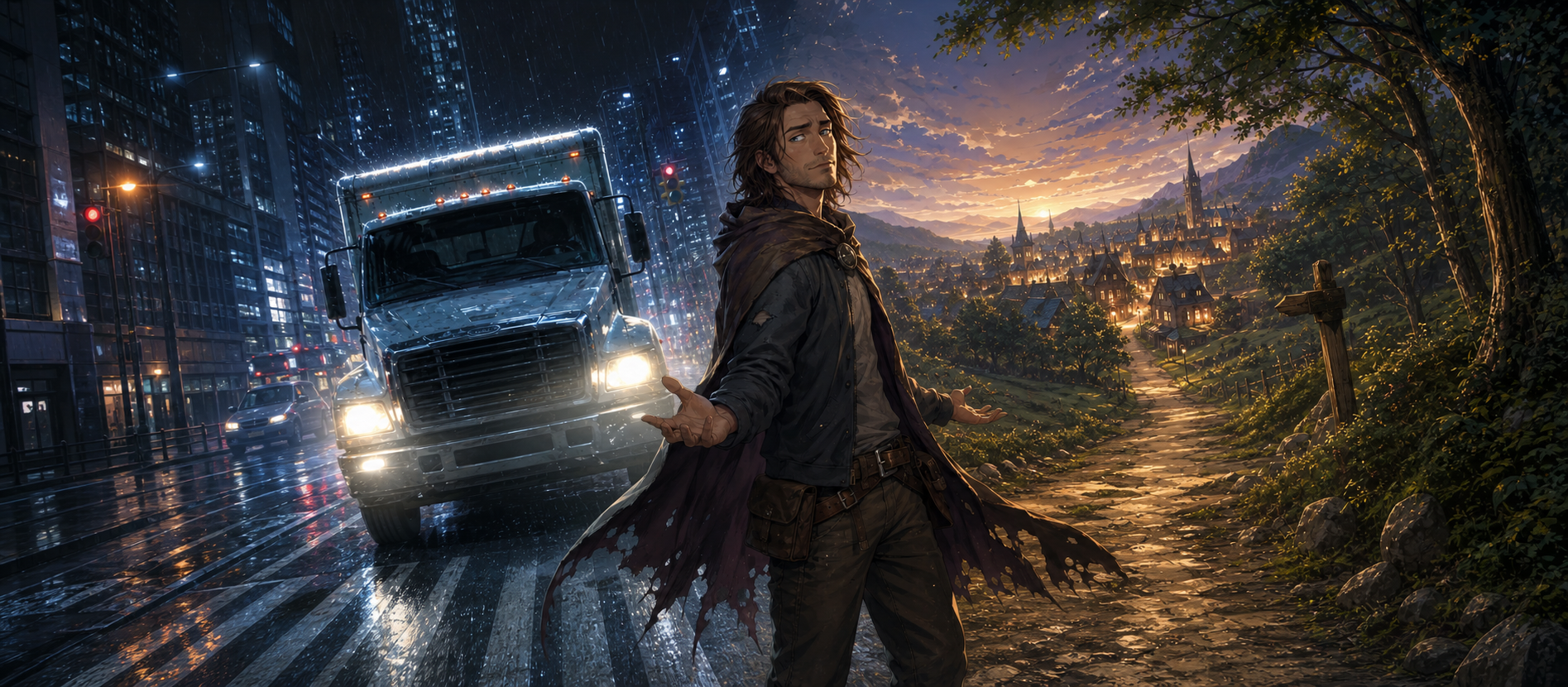
Reborn to Die... Another Way!
Chapter 7 — Threshold
The final meters stretched out as if the field had widened specifically for him. The gaze of the man with the animal was already fixed upon him, the woman stood frozen beside him, and now all that remained was to not break into a run or collapse into a furrow under their scrutiny. He held his hands slightly away from his body, showing that his palms were empty. Dust clung to his face; the split seam on his shoulder tugged at the fabric with every breath. Everything inside him pleaded to turn back, toward the trees, where at least there were no foreign eyes, but the forest meant night, cold, and another meaningless awakening. Alex took another step. Then another. Only a few meters remained between him and the two workers, and each one felt like a separate decision.
He stopped ten meters away. The air between them grew dense, almost tangible. Details now cut into his vision: the hoe hanging from the harness of the draft animal—a common tool with a curved blade covered in earth, not a weapon. The beast snorted, the thick fur on its broad back rippled, and it turned its large head toward Alex with dark, indifferent eyes. The man said something—an inquisitive intonation, steady, without open threat, but demanding an answer. The words sounded like heavy stones rolling down a slope: unfamiliar, coarse, completely alien. Alex slowly raised his open palms and shook his head from side to side. "I don't understand." The gesture was all he had left. The man repeated the phrase—louder, slower, emphasizing every syllable, as if that could break through the barrier. A silence hung thick, like the dust on the field. Language didn't work. Not a single bridge. In his past world, gestures and intonations only frightened people, provoking aggression. Here—emptiness. Alex felt naked under their gaze, vulnerable to the point of trembling in his knees. The man didn't panic, didn't reach for the hoe, but his alertness had weight—in his narrowed eyes, in the way he shifted slightly, shielding the woman. This was an assessment. Not fear. Just a dense, heavy caution.
The pause lasted too long. Alex could hear the animal shifting in its harness, an invisible insect chirping somewhere behind their backs, and his own breath breaking into a dry whistle. He tried to smile, but realized just in time that a smile on such a face would look like a convulsion. He lowered the corners of his lips, leaving only his open palms. The man's gaze slid to his hands, to his sides, to the ground beneath his feet—checking for a knife, a stone, an intention to lunge. The woman looked differently: not softer, but more attentively, as if he were not only a potential evil but some kind of task that needed to be solved before the end of the day.
This mundane sobriety made things scarier and easier at the same time. He wasn't being written into a legend, wasn't being designated a monster from his first breath. They were simply deciding what to do with a person who had appeared at the wrong time.
Alex pointed a finger at his mouth, then pressed both hands to his stomach, signaling something simple: food, water, help. He showed his empty palms—open, non-threatening. With a gesture backward toward the forest, he swept his arm wide to indicate the void: alone. Nothing. From nowhere. The man followed every movement, his face remaining motionless. The woman tilted her head slightly. Her gaze slid down—over the soiled clothes, the dark stains—and stopped on the torn jacket and shirt just below the ribs. On the narrow puncture with a dark crust around the edges, where the fabric was stiff and saturated with old blood. She touched the man's arm, nodded toward Alex, and said something quiet, almost a whisper. The man looked. His jaw tightened, the muscles in his cheeks defining.
Alex stood with his arms down, letting them look. His hand instinctively twitched toward his side—to cover, to hide the narrow puncture with its rim of clotted blood—but it immediately dropped. The mark remained open. In his past world, this would have caused fear; hands would have reached for weapons, whispers of a bandit. Alex's shoulders tensed, his weight shifted to his toes, his body preparing to retreat. But the man did not reach for the hoe. Instead, they exchanged a long look—silent, like years of living together where words are unnecessary. In her eyes, it read: "He is wounded." In his—a question, an answer, a bargain. The woman said something quiet and calm, her voice steady. The man exhaled through his nose, a long breath, as if shedding a weight. His facial expression shifted: it didn't warm, but it changed—from "threat assessment" to "problem assessment." The pattern cracked. The expectation of pain did not come true. A gap in the template. Not a rupture, but a crack. For the first time, he wasn't being driven away or feared. Only watched. And decided upon.
The tension receded, and his body gave in. Alex's knees buckled suddenly, as if someone had pulled a rod out of his spine. The world tilted, his vision narrowed into a tunnel—the edges of the field darkened, the sun became too bright. He steadied himself by placing a hand on his thigh, fingers gripping the worn fabric of his trousers. His breathing came heavy and raspy, his chest heaving. This wasn't a game—hunger, dehydration, the crossing of the field, a sleepless night by the fire, death, awakening, the forest again. It all crashed down at once. The woman took an involuntary step forward, her hand rising slightly. The man touched her elbow—not to hold her back, just to remind her: wait. Alex straightened up slowly; his head was spinning, but he stood. There was no mask left on his face, no attempt to play a role: a dull gaze, hair matted with sweat, slumped shoulders. No pose. Just exhaustion. The man studied him for another second, long as an eternity. Then a decisive exhale, a nod to the woman—short, concrete. The decision was made. The vulnerability that could not be hidden turned out to be the very thing that deserved at least a minimum of trust. Not a hero. Not a threat. A problem. And this was the first human interaction.
The man stepped aside, nodding his chin in the direction of the settlement: come on. The gesture was clear, without illusions—not "welcome," but "you may come, but on my terms." No outstretched hand, no smile. He took the rope of the harness and turned toward the path; the draft animal snorted and followed. The woman picked up her wide basket, cast one last assessing look at Alex—not hostile, not warm, just a full measure of the man standing before her—and followed the man. They didn't look back, assuming he would follow. And he did, fifteen paces behind, at an unnegotiated distance. His shoes slipped in the dusty rut, the fabric of his sleeves catching on dry stalks. This was the best outcome across two worlds, and this fact was simultaneously comforting and heartbreaking. An invitation without words, conditional, silent. He couldn't clarify, couldn't bargain. He just walked.
They moved along a dirt path between plots, the settlement growing ahead. Steep, sharp roofs cut the sky, smoke rose from chimneys in thick columns, carrying scents that made Alex's stomach tighten even more: baked bread, roasted meat, something herbal and living. A distant child's scream sliced through the air, a dog's bark answered it, and the rhythmic thud of an axe or hammer echoed off the walls. Life. Real, ordinary, foreign. The woman and the man spoke quietly, their voices merging into the melody of an unknown language—rhythm, intonation, nothing more. The draft animal occasionally turned its broad head toward him, looking with large, uninterested eyes, its fur rippling in time with its steps. They reached the boundary—low stone walls, without gates, just a natural threshold. The man stopped and pointed to the ground by the wall: wait here. The meaning was clear without words—you do not enter on your own. We will decide. The woman set down her basket, nodded to the man, and went inside first, her figure dissolving in the opening. The man remained, arms crossed over his chest—guarding or waiting, probably both. Alex sank to the ground by the wall, leaning his back against the cool stone. Its roughness scratched through his thin shirt, but it was almost pleasant. He looked through the opening: people were moving inside, living, existing—silhouettes, laughter, smoke, smells. The man glanced at him. Alex met his eyes, gray and tired. No one spoke. The man turned away first, back toward the settlement. Alex closed his eyes for a moment—not sleeping, just resting while he could. He heard the life beyond the wall: the thudding, the voices, the breath of a world he could not reach. This was the most human treatment across three worlds—cautious, without sentimentality, without enmity. And it was precisely this that made the desire to stay sharper than any phantasm.