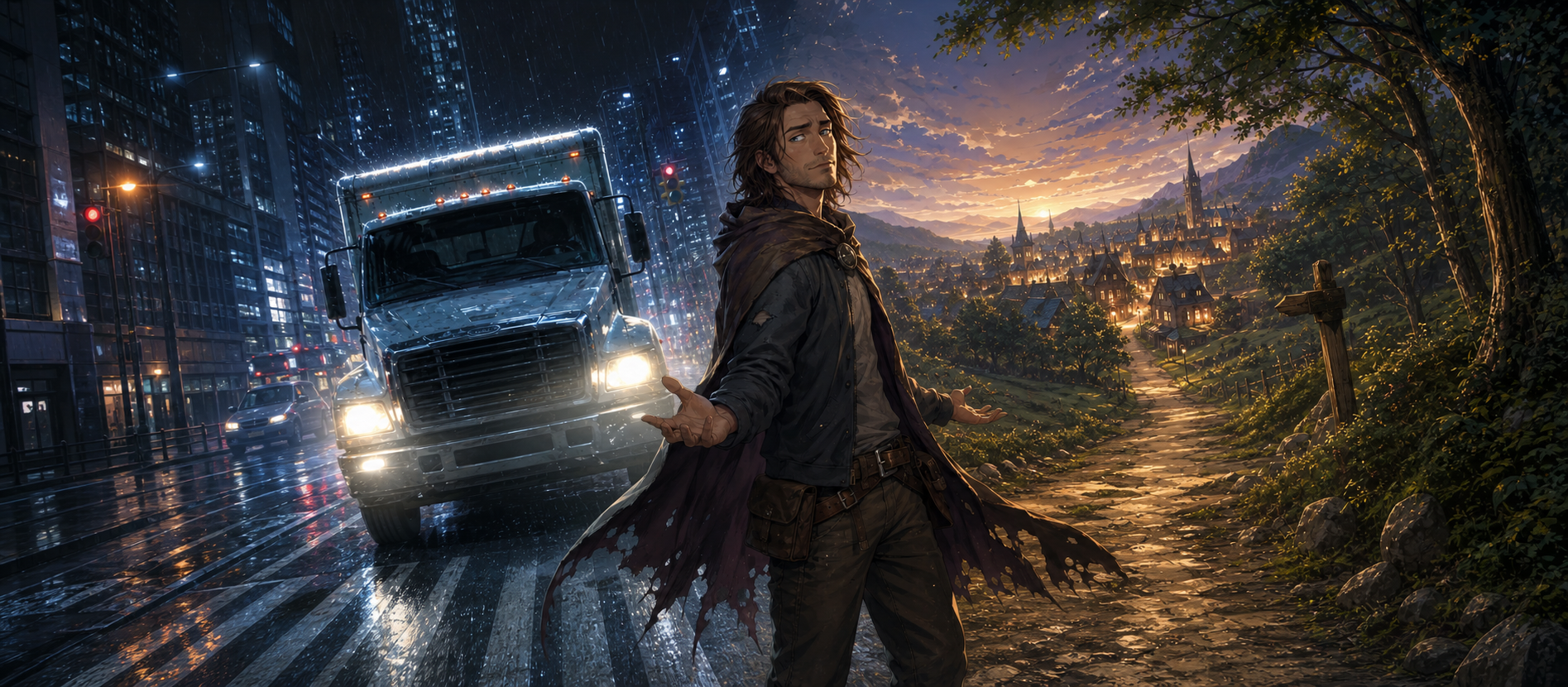
Reborn to Die... Another Way!
Chapter 6 — Traces on the Fabric
Alex opened his eyes, his face pressed into the damp grass. The taste of earth and bitter greenery filled his mouth, and the morning light broke through his eyelashes in a thick, golden stream, entirely different from the light in the previous forest. The birds overhead emitted low, heavy trills, as if plucking coarse strings, and the air smelled of decaying leaves, wet soil, and something fungal, without a hint of pine. Not the same forest. But his body already knew what was coming next.
He lay motionless for several long seconds, allowing his senses to return. His shoulder throbbed with an old pain carried across worlds, his wrist ached from an old abrasion, and his neck was stiff, as if it had been twisted and left in one position all night. Almost no strength remained—his muscles felt like lead, and his head swam with weakness. Slowly, with effort, he rolled onto his side. The memory of the campfire, the vagabond's panicked lunge, and the wet thrust to his side returned not in words, but as a flash: pressure, warmth, then cold. He knew there should be no wound. And yet, his hand reached for his side of its own accord.
His fingers touched the fabric beneath his jacket. The skin under it was intact, smooth, without a single mark. But the shirt... the shirt bore the mark—the clean edges of a puncture, stiff with dried blood. His hand trembled. He sat up, pressing his palm tighter, as if that could change anything. The feeling was flat, almost dead: recognition without surprise. Forest. Morning. A body that had survived, but remembered everything.
Rising to his feet, Alex staggered. His knees buckled; the world swayed once, then twice. A few steps away, a mossy stump loomed, covered in a thick, damp carpet. He lowered himself onto it, feeling the moss give way under his weight and the cold seep through his trousers. His hands habitually searched his pockets. Empty. No phone, taken by the guard at the gates, no keys, no wallet dropped in the mud. Only deep in the lining of his jacket did he find a crumpled, faded receipt—a scrap of paper from a world where he had bought a cold dinner and a can of coffee before stepping out onto the road. The ink had long since blurred; the date had vanished. A useless thing. He twirled it in his fingers, then shoved it back. Nothing. Not a crumb of food, not a drop of water, not a coin, not even a broken branch that could be used as a walking stick. Only worn clothes and a body that now ached across three consecutive worlds.
Weakness rose from within like a heavy wave, bringing sour saliva to his mouth. Alex closed his eyes, trying to recall the taste of the charred root by the campfire, but the memory only intensified the frailty. The sun warmed the crown of his head, illuminating dirty, tangled strands of hair. Once, this face had been considered handsome. Now it simply looked tired. His jacket, once dark blue and professional, hung on him like a sack; a seam at the shoulder had ripped, and the fabric was saturated with dirt and old stains. The shirt beneath it had become a kind of chronicle that could not be hidden.
The forest around him did not mirror the previous one. The trees rose higher, the trunks were thicker, the bark dark, almost black in the shade, with broad leaves that rustled heavily and earthily. Thick, damp moss sprang beneath his feet, clinging to his soles. The air seemed denser, sticking to his skin, mixing with the smell of sweat and his own exhaustion. Not pine. Not that world. But the sequence remained the same, and this knowledge sat somewhere below thought, in his muscles and bones.
Alex stood up. His legs grew heavy, every step echoing with a dull pain from his soles up to his thighs. He looked around. A narrow path stretched along the edge of the woods—simply a path where the grass did not grow. To the left came the muffled sound of a stream. To the right, through a gap in the canopies, it grew lighter—the forest was thinning. Last time, he had chosen the path toward people. And that had ended with a rusty blade in his side. But staying here meant waiting for the weakness to take over. He turned right. Toward the light. Toward the open space. Because his body already understood: the forest always ends in fields, and fields end in people.
Step after step. The path wound, narrowing between trunks and then widening. Sunspots fell on his shoulders—warm, almost soothing—then vanished into deep shadow. Every unexpected rustle made him flinch: the snap of a twig underfoot, the whisper of leaves overhead, a distant crack. His hand reached for his side again and again, fingers tracing the stiff edges of the hole in the fabric. There was no wound, but the memory pulsed—the sensation of the thrust, the spreading warmth, then the cooling fingers. "Don't think," he muttered aloud. His voice sounded hoarse, foreign. He caught himself mentally beginning the familiar narrative: the hero emerges from the forest, exhausted, but with the experience of past worlds behind him. The thought provoked disgust. Last time, this "hero" had simply bled out by the campfire while a terrified vagabond fled into the darkness. The frame that had once warmed him on his way home from work now seemed cheap and unnecessary. He forced himself to focus on the simple. One foot. The other. Breathe evenly. Do not look for what is not there.
The forest contracted and receded. The path grew wider. The scent changed—something fresh and distant mingled with the thick vegetation, as if fields truly lay ahead. The sun rose higher, heating him more intensely. Sweat ran down his back, soaking the fabric. Every step resonated in his shoulder and hips. Hunger became a constant background—heavy, aching, granting no peace. He did not allow himself to think of a repetition. He did not formulate it. But below the words, in his body, a quiet, heavy recognition was already ripening.
Halfway through, he stopped. Sunlight fell on a small clearing ahead, golden, almost staged, highlighting a distant glimpse of cultivated land beyond the trees. Something in this angle—the light on the leaves, the silhouette in the distance—hit him like a wave, bringing nausea to his throat. Not from weakness. Forest. Path. Clearing. People. Suspicion. Pain. He uttered no word for it. Such a word did not yet exist in his mind. But his muscles tensed, and his breathing became shallow. He stood motionless for a full minute, swaying slightly. The thought of simply sitting here, on the path, and not moving further suddenly seemed seductive. Let everything take its course. But hunger pushed harder—a sharp, demanding void that made his vision darken. His body demanded movement. His body remembered what it meant to lie without strength. Alex took a step. Then another. Faster now. Not out of hope. Out of necessity. To find anything at all before his legs gave out completely.
The path led him to the edge. The forest ended abruptly, as if someone had cut through a green curtain. Alex crouched behind the last thick trunk, pressing his palm against the rough, damp bark. Cleared land opened before him. Not small fenced plots, as in the previous village, but wide, sweeping fields with long rows of tall, dark-stemmed grain, its heavy ears bowing toward the earth. Distant buildings rose with steep, sharp roofs, nothing like the low thatched roofs behind the palisade. Smoke rose from several chimneys—thick, white, promising warmth. The scale was different: larger, more open, sprawling across the valley.
People were visible as small figures in the fields—too far to make out faces, but their movements were familiar: bending, waving arms. The wind carried sounds: a rhythmic thud, as if metal met wood, the short low cry of some animal, muffled voices. The world was working. Living its own life. And it was completely alien. The architecture was different. The landscape wider. Even the air had a different aftertaste—less smoke, more greenery and dusty freshness. Alex noted all of this, and the feeling simultaneously calmed and frightened him. This truly was a new world. He had no map for it, no knowledge, not even the imagined spells he had once whispered in desperation. Only a body that barely held together and clothes that carried too much.
He watched from cover. A woman with a wide basket on her head crossed between plots—the basket was full of heavy greens. Her movements were fluid, habitual. A bit further, a man led an animal along the path between the fields. No one held a weapon. No clubs, no axes. Both were occupied with work: the woman adjusting her load, the man quietly muttering something to the animal, patting its side. The scene looked peaceful. Ordinary. Real. This only made it harder.
His body leaned forward on its own. Muscles tensed, weight shifted to his toes. He had to go. There was no other choice. The cold of the nights, the weakness already creeping into his bones—everything demanded movement. His hand rose, fingers tracing the edges of the hole in the fabric at his side. Last time, it was exactly this—strange clothes, marks—that changed the look in people's eyes. First wariness. Then rejection. Then fear. And fear always led to pain. He knew this in his skin. But hunger pushed harder, reminding him that if he didn't move now, the next awakening would be even worse.
Alex straightened up. Slowly, as if afraid to startle himself. He stepped from behind the tree into the open space. Sunlight hit his face, warm and bright, forcing him to squint. He began to walk across the field. His feet sank into the soft soil between the rows, each step kicking up a light dust. The man with the animal noticed the movement first. He stopped. Turned. Squinted toward the forest. A figure in worn clothes was approaching. The man's hand rested on the animal's harness—not as a weapon, but as a point of support. He said something short in a low voice. The woman turned. The basket swayed on her head. Both were now looking directly at him. Alex continued to walk. The sun beat into his eyes, exhaustion splashed in every cell, and in his chest, somewhere below everything else, there stirred only one heavy, unspoken recognition.