Reborn to Die... Another Way!
Chapter 9 — The Woodpile and the Manure
Alex woke to a cold that had seeped through his thin shirt and bitten into his skin. The smell of damp straw, cow breath, and a sour, earthy infusion hit his nostrils, thick as a fog over a swamp. He was lying on his side, straw pricking his back, and one particularly stubborn splinter had already managed to lodge itself between his shoulder blades. His body ached: the abrasions on his palms stung, and the tire marks on his jacket pulled at the fabric, as if reminding him of every fall. His eyelids slowly opened, focusing on the dark silhouette of a cow chewing with lazy indifference, oblivious to the stranger in its corner.
He sat up, grimacing, and shook the straw from his long chestnut hair. The night after Arno and Ilsa had left had blurred into a total oblivion by the woodpile—the splitting maul had remained lying in the dust, and Alex himself had simply collapsed beside it, too exhausted to move. Apparently, someone from the locals had decided not to leave him in the street: hands, not rough but accustomed to hard labor, had carried him here, into the barn. Now this was his temporary shelter. The thought came without the usual spark of adventure—just a silent resignation. To keep from being kicked back into the forest, he had to work. To show that he was useful. He took a step, his legs buckling for a moment, but Alex grit his teeth and walked out into the yard, where the light was just beginning to break.
The yard greeted him with morning dampness. Arno and Ilsa stood slightly apart, apparently called upon again as the ones who had brought the stranger. Beside them stood a sturdy man in his fifties—broad-shouldered, with a face furrowed by deep wrinkles, like earth after a long drought. Village Elder Holger. He wasted no time on greetings, nor did he ask for a name or where Alex had come from. He simply stopped three paces away, crossed his arms over his chest, and surveyed him with the look one uses to inspect an extra bag of grain or a broken cart. Holger's finger poked at the mark on the shirt. He grunted low, almost soundlessly, and turned to Arno. The words flowed quickly, businesslike—short phrases in which there was no suspicion, only calculation. Every mouth in the community counted, especially now.
Ilsa stepped closer. She repeated the gestures Alex had already seen yesterday: she pointed toward the forest, mimicked a sharp stab in the side, then spread her palms to show the emptiness around him, and touched her stomach, imitating hunger. Arno nodded in confirmation, adding a few words. Holger listened without changing his expression. Finally, he chopped the air with his palm—the verdict was delivered. One night under supervision. If he ran away or stole even a single thing—the gallows by the wall. If he worked without complaint—we'll see. No questions about the past, no hint of a special role. Only practical calculation: the community was preparing for something, and extra hands could be useful, even ones as weak and foreign as these. Alex stood motionless, feeling how the rope from yesterday's knot still burned his wrists. This was not a hero's sentence, but simply an entry in an invisible ledger. Holger turned away, as if the matter were settled, and waved his hand toward the far wall of the yard.
There, by the low stone walls, stood a heavy, crooked wooden wheelbarrow with a single handle and a pair of rusty pitchforks stuck in the ground nearby. Alex instinctively straightened up, expecting what came next. Yesterday's ultimatum from the guard with the splitting maul still echoed in his head—"chop wood or die"—and now he understood: that hadn't been the final sentence, but the first barrier. The manure barrow turned out to be a trial step, a test before being trusted with real work at the woodpile. Perhaps now they would point to something else—a basket for herbs, a letter, or at least a broom for the yard. Instead, Holger poked his finger toward the pigpen, then toward the distant compost pile beyond the opening, and made a short, repeating gesture: clean, load, haul. The task was clear even without a single understandable word. Scoop the manure from the pen and take it to the pile. Alex blinked, trying to process this. He raised his hands palms up, then mimicked something like grabbing an invisible lever, clutching his lower back with a grimace of fatigue. The gestures were clumsy but sincere—an attempt to explain that his body was not used to such work. No one reacted. Holger had already turned to Arno, discussing something of his own. Ilsa only shrugged, as if saying, "Those are the rules." The barrow waited.
Alex approached it, feeling the dust crunch under his feet. The handle was rough, darkened by the sweat of many hands. He gripped it with both palms—the abrasions immediately began to throb—and pulled. The barrow proved to be heavy, with a treacherous center of gravity. The wheel veered to the side, and the nose dipped sharply. The load—a thick, fresh mass from the pen—tumbled over the edge and flooded over his feet, soaking his worn trousers and frayed shoes. Alex slipped, trying to maintain his balance, but the barrow finally tipped over, pinning his knee. The smell hit his face, thick and acrid. He froze for a moment, feeling the sludge seep through the fabric, cold and sticky. His back strained from the effort. But he had to get up. Alex rose, brushing off his hands, and gripped the handle again. The barrow resisted as if it were alive: every movement required a precise balance he didn't possess. The wheel constantly got stuck in ruts, and the load tended to slide sideways. He had to lean in, pushing with his whole body, and every strained step echoed with pain in his shoulders and back.
He made the first trip to the compost pile beyond the opening. The manure squelched under his feet, the barrow creaking like old hinges. Sweat streamed down his temples, mixing with the dust. When the pile had finally grown, Alex returned for a second portion. Now he tried to keep his balance, but his muscles were already trembling from the unfamiliar load. The third trip ended with the wheel hitting a soft rut, and the barrow overturned again, dousing him in a new portion of sludge. He stood there, breathing heavily, looking at his mud-covered hands. He gave a dry, internal chuckle: this was no adventure. This was simply work that had to be done to stay. To avoid returning to the forest, where the night was full of uncertain sounds. He lifted the barrow again, leveled the load, and moved on. Every step was a small victory over his own body—his muscles burned, his palms stung, but he did not stop.
After the manure, Holger, without looking, pointed to the well at the edge of the yard. Now—water. A wooden yoke lay nearby with two buckets. Alex took it and slung it over his shoulders. The wood immediately bit into his skin, chafing the old abrasions. He lowered the first bucket into the well, heard the splash, and pulled it up. The water was cold and heavy. The yoke swayed, and water splashed onto his feet, making the ground slippery. The second time—the same thing. His shoulders burned, his back ached, but he walked, placing his feet along the dusty rut. On the fourth trip, while the buckets were full, a cart rolled around the corner. A local boy—a thin teenager of about sixteen, with dark hair and a practical gaze—shouted something sharply, waving his hand: "Out of the way!" The intonation was clear without translation—the irritation of a tired person being hindered. Alex didn't make out the words, but his body reacted on its own: he pressed himself against the fence, dropping one bucket. Water flooded into the dust, absorbing instantly.
He froze, waiting. In previous worlds, such a moment would end with a blow or a scream. But the boy—Bram, as Alex later understood from the gestures of others—simply rolled his eyes, jumped off the cart, picked up the bucket himself, and slid it back under the yoke. He nodded toward the well: "Do it again." Without anger, without unnecessary words. Just routine. Language remained a wall, but fatigue and shared work made it slightly more transparent. Alex nodded in response and took up the yoke again. His shoulders burned, water splashed again, but now there was a strange coordination to it. He hauled water until the sun rose higher and the yard filled with ordinary sounds—the creak of carts, the lowing of livestock, distant voices.
By evening, Alex sat on the edge of a wooden trough by the wall, wiping his face with a dirty sleeve. His hands were crusted with grime, his palms covered in fresh blisters that had already begun to bleed in the places of the abrasions. His shirt, soaked in sweat and dirt, pulled unpleasantly against his skin with every movement, reminding him of the price of entry. His shoulders burned from the yoke, his legs trembled. He looked at his boots, splattered with manure, and felt something shift inside. Not a triumph, not a sudden strength—just a calm acceptance. Bram approached silently. In his hands, he had a clean rag and a small sour apple, already sliced on one side. He handed them over without ceremony, without a smile. Just a fact: you did part of the work, here is your share. Alex took the rag with trembling fingers and wiped his face. The apple was hard, sour enough to make his mouth pucker, but after a day of such work, it seemed like a true delicacy. He chewed slowly, feeling the juice spread across his tongue. The warmth in his chest wasn't loud—just the feeling that he hadn't been kicked out. That he had found a tiny, dirty, but real place in this yard.
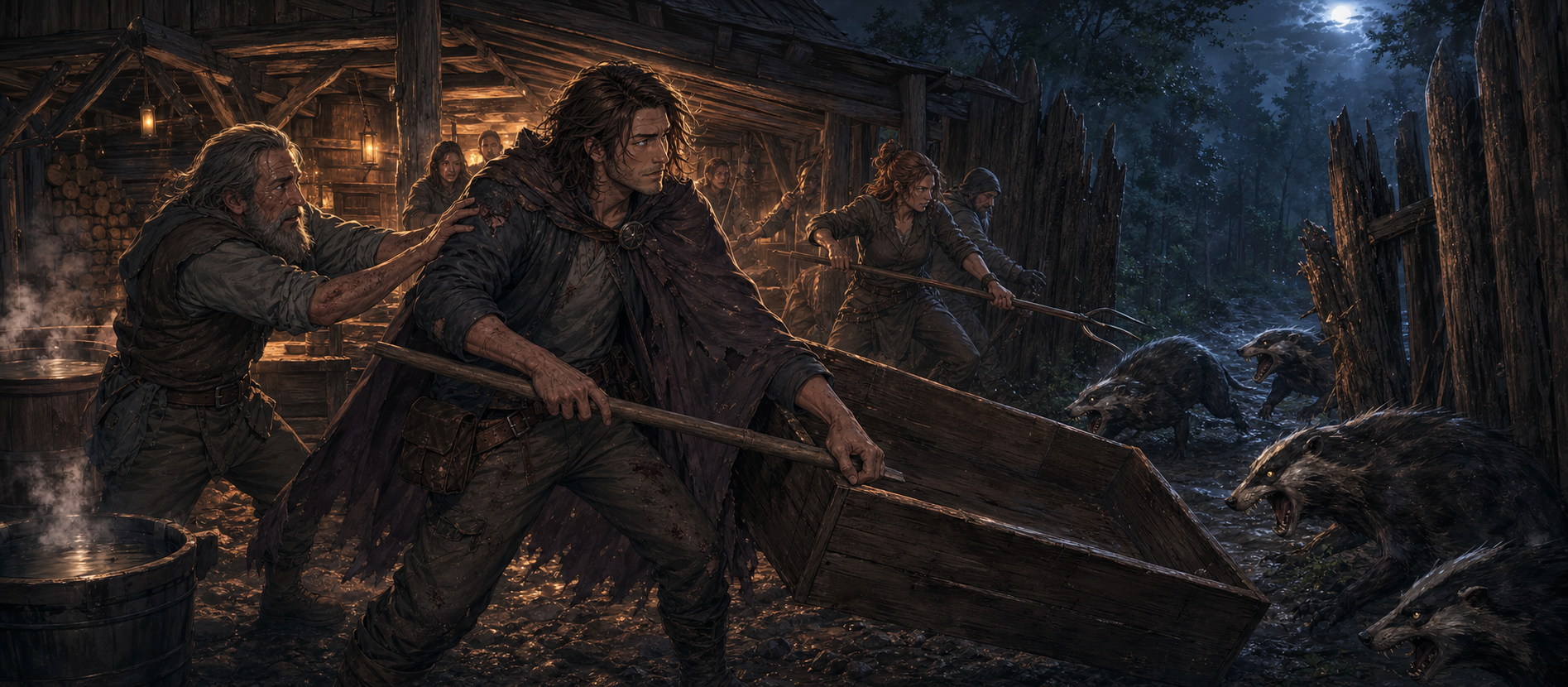
Already staggering, Alex headed back to the barn when he heard voices in the twilight by the well. Holger and Torsten—the guard with the club who had searched him yesterday—were standing by the wall. They were speaking quickly, in low voices. Torsten pointed sharply toward the forest, making a wide gesture with his hand, as if showing something plural, large, and approaching. Holger nodded, then poked his finger toward Alex, then toward the opening in the wall and the modest food supplies stacked by the shed. The gestures were eloquent: he had been kept not out of pity. Hands were needed. Tomorrow or very soon, something—or someone—would come from the forest, and the community would have to hide resources, prepare defenses, and count every piece of bread and every pair of hands. The trial period turned out to be tied not to mercy, but to this threat. Alex froze in the shadows, holding his breath. The apple in his stomach suddenly felt heavy. He had wanted to stay—and now he saw the price. This was no fairy tale. This was a community that survived by grinding everything to fit its needs. His blisters and his work could become part of this machine. Or not. He stepped into the barn, straw crunching under his foot. The smell of damp grass enveloped him again. One thought spun in his head: one more day. One more trip. And we'll see what the forest brings.