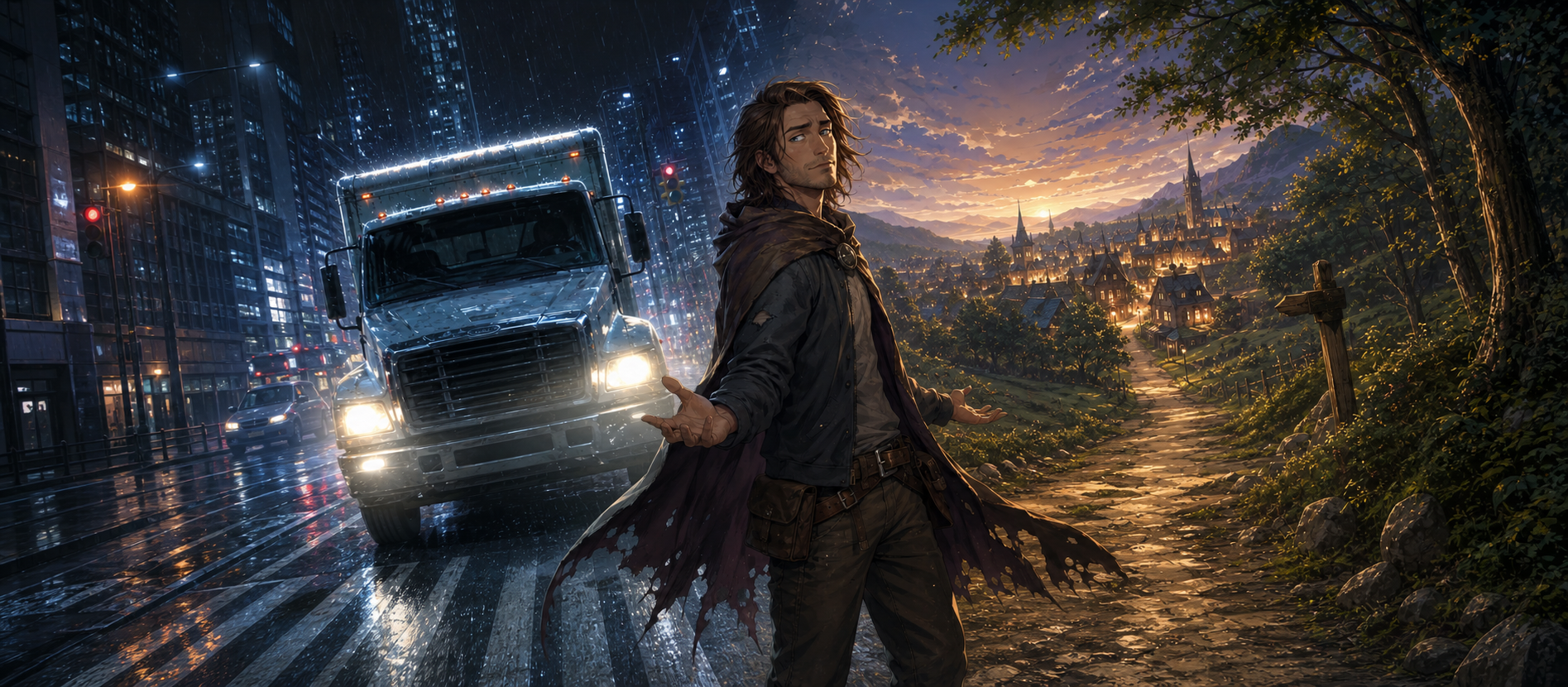
Reborn to Die... Another Way!
Chapter 4 — Bargaining at the Gates
The sun was already touching the treetops of the forest, painting the sky in a thick, inflamed crimson. Shadows from the trees stretched across the road like long black fingers, clutching at his shoes. Alex walked, moving his legs mechanically, but the void inside—that same quiet, deep emptiness with which he had been pushed beyond the outskirts—began to rapidly fill with a concrete, sticky reality.
He had no food. No water. His parched throat reminded him of its state with every breath. And as the forest on both sides of the road began to swallow the light, a dampness wafted from the thicket, accompanied by an unfamiliar, alarming rustle—not the wind, but something heavy, breaking dry branches.
Alex stopped. He looked back. The village, a hundred and fifty paces away, was the only landmark in a world he had seen even slightly. There was light there. There were people. This wasn't pride or hope—it was raw, animal pragmatism. Dying in the bushes was stupid. He turned around and headed back toward the gates.
The palisade of sharpened logs, blackened by time, rose out of the twilight. Against the backdrop of warm lights flickering inside the village, the silhouette of a guard stood black against the gloom. Hearing footsteps, the large man turned. His hand rested on the hilt of his club.
Alex stopped ten paces away. Slowly, trying not to make any sudden movements, he raised his palms to chest level. It was a gesture he had seen in a hundred movies, but now, in a blood-stained jacket and dirty jeans, in the middle of an empty road, he felt ridiculously absurd. His hands shook betrayingly.
The guard barked something short and crude. The tone left no room for doubt: "Go away."
Alex didn't go. He remained standing, lowering his hands only halfway.
He began to gesture. He pointed to himself, mimed digging with a shovel, then carrying a heavy load, then sweeping. He pointed to the village, then pressed a palm to his mouth—food. He repeated the cycle twice, trying to make the movements as clear as possible.
The guard watched him. There was no hostility in his eyes. Alex began to recognize this expression—it was a tired, stony indifference. He had seen vagabonds like this. He knew how such stories ended. The guard gave a short shake of his head and turned back toward the road. End of conversation.
Something inside Alex turned cold. This wasn't even a personal rejection. The guard simply didn't want to waste his time on him. There was no anger, no contempt—just "you aren't worth my attention." It was devaluation without emotion. Alex realized that indifference was more terrifying than enmity. Enmity could be reasoned with; there was no lever for indifference.
But the fear of the approaching night pushed him further. He looked around and noticed a woodpile against the outer wall of the palisade. The firewood there wasn't split; it was dirty, still covered in bark. With hope, Alex pointed to it, joined his hands in a peaked shape and mimed a strike with an imaginary axe, then pointed again toward the gates.
The guard followed his gaze. He looked at the woodpile. Then back at Alex.
A pause hung in the air for a moment. Alex saw something shift in the man's eyes: he was evaluating his hands, gauging his silhouette. "He's thinking," flashed through his mind. "He's actually thinking." But then the guard's gaze slid over the blood-stained jacket, the dirty jeans, the alien, incomprehensible appearance. The moment passed. The guard shook his head and decisively waved his club toward the road, away from the village.
Alex grit his teeth. He saw the decision form and then crumble. Not because he couldn't work, but because of how he looked. The clothes he hadn't chosen, the blood from abrasions, the strange appearance—they had become an invisible wall. His own body was working against him.
One last card remained. Alex peered at the guard and noticed a detail: the man's left wrist, gripping the club, was unnaturally crooked, and the wrist was tightly wrapped in dirty cloth, beneath which a bluish swelling protruded.
Alex pointed to the injured spot. He mimed a "I can help" gesture: carefully washing, bandaging, stabilizing. He tried to straighten his back, stop the shaking in his hands, and look competent and confident.
The guard followed the gesture—and his face changed. Gratitude did not appear. Suspicion did. A stranger points out your weakness, your vulnerability, and says he can reach it. In this world, stranger's hands reaching for your pain meant only one thing.
The guard took a sharp step forward. In real-time, Alex realized how his "help" had been read. His knowledge, his confidence—they were not a shield. It was the suspicious gesture of a stranger who had crossed the invisible line from "pitiful vagabond" to "potential threat."
The guard roared something short and hoarse, and violently shoved Alex in the chest.
Alex lost his balance. He crashed down onto one knee, his shoulder slamming hard against a stone hidden in the grass. Pain shot up his arm to the elbow, echoing with a dull thrum under his collarbone. His wrist flew out and scraped the skin against the gravel, reopening yesterday's abrasion; hot blood immediately mixed with the dust.
The guard loomed over him. The club was still on his belt, but the man's hand rested on the hilt. The gaze was heavy and silent: the next shove would be with the club.
Gritting his teeth against the pain in his shoulder, Alex crawled back a few steps, continuing to keep his hands raised—no longer in a gesture of negotiation, but in a gesture of absolute surrender. The guard cast one last look of pure disgust at him, turned, and strode back toward the gates.
It wasn't as painful as the hit from the truck, but it was a thousand times more humiliating. This was the pain inflicted by a fellow human who decided you didn't even deserve a proper conversation. The boundary of this world was drawn not with words, but with the body.
Alex didn't go far. He made his way to the roadside and leaned his back against a thick, rough stone lying near the root system of an old oak. He remained within sight of the gates, but beyond the guard's reach.
Inside him, a quiet, long monologue played out, devoid of drama. He reviewed his three attempts and saw a lethal pattern. Each subsequent one had been more honest than the last. First, he tried to explain that he was a "hero from another world." Then he sank to gestures of "I just want to eat." Finally, he offered "I can heal you." And each was rejected faster than the one before. The world didn't demand heroism from him. The world demanded that he be understandable. And he could not be understood.
Sounds of life drifted from the village: the creak of a heavy door, muffled voices, the short bark of a dog, the thick, savory smell of smoke from hearths. Alex felt hunger. Not metaphorical, but physical: a hollow, pulling spasm beneath his ribs. His shoulder pulsed steadily in time with his heartbeat. He was frozen in no-man's-land—close enough to the warmth of others to smell it, and far enough to be absolutely alone.
The guard stepped inside. The gates closed with a heavy, deafening crash. The sound of wood hitting wood rang out like a gunshot. Final.
The last lights vanished instantly from behind the palisade. Only the heavy scent of cooling smoke remained. The air temperature dropped, piercing to the bone through the thin fabric of his jacket.
Alex was left alone in the dark.
Silence hung for several minutes. And then, from the direction of the forest, from the black wall of trees, came a sound. It wasn't a howl or a scream. A low, prolonged, vibrating hoot that transitioned into a guttural roar, from which the ground seemed to tremble slightly. Alex had never heard anything like it before. He didn't know what it was—a giant owl, an unknown beast, or the wind itself in the crevices of the rocks.
But his body reacted before his mind. Goosebumps ran down his neck, his leg muscles turned to stone, and a sharp, primal urge arose to press his back against something solid, to cover his vulnerable spots. He looked toward the sound—there was only impenetrable blackness. He looked at the road—it vanished into the darkness in both directions, lost in the fog. He looked at the gates—they were shut tight.
A simple, raw thought flashed in his head, without pathos or despair: "I need to find somewhere to go before dawn."
With effort, Alex peeled his back away from the stone and stood up. Ignoring the pain in his shoulder, he began to walk along the palisade—not into the forest and not toward the gates. Slowly, by touch, he searched for a gap, a protrusion, any indentation in the logs that would give him at least a wall behind his back.