Interstellar Spectators
Barbenheimer and the Collapse of Objectivity
In the Control Center, the air always smelled of stasis and overheated electronics, but today, there was an almost physical premonition of catastrophe mixed in. Tarra stood by the main screen, fidgeting with the hem of her anthropological jacket, watching as OKO displayed the weekly cultural digest. The voice of the onboard intelligence, which had perfected a tone of passive aggression over millennia of listening to Earth's call centers, flowed through the bridge like a resonant sigh:
— Twenty-ninth week of the year by the Earth calendar. Phenomenon: "Barbenheimer." A contrast synthesis of cinematic narratives. Threat assessment: undetermined, as logic is absent.
Two images pulsed on the screen: a neon-pink world where everything was edible and shimmering, and a black-and-white ghost of a desert where human shadows blurred from radiation. Tarra frowned, habitually searching for patterns. This was a ritual, this was a collective obsession, this was…
— The hegemony of glamour! — Kluk burst in, literally flashing in the doorway.
His plastic form, usually a vague grayish-blue, was now radiating a neon-pink light so intense it made the eyes ache. Kluk's body had taken the shape of an idealized plastic creature with joints bending in anatomically impossible directions. He soared into the air, leaving a trail of glitter behind him, and landed on Tarra's console.
— These aren't just movies, Tarra! This is plastic existentialism! This is the triumph of surface as depth! — Kluk gestured, his limbs making sounds like new sneakers squeaking on a parquet floor. — We must protect the pink spectrum. It is defeating the darkness. It is…
— Atomic fission, — a cold voice sounded from the corner.
Querr shimmered in the dim light, his crystalline body reflecting a cold gray-green glow reminiscent of uranium glass. Every facet of his form was a precise mathematical plane, emitting a barely audible crackle of ionization.
— Historical fatalism, — Querr continued, slowly rotating on his axis. — The contrast between high culture and mass hysteria. Not "plastic," Tarra, but the cyclopean tragedy of progress. In 1945, they were already making mushrooms, only those were radioactive.
— This is a cognitive threat, — Brax suddenly declared, stepping out of the shadows with a scanner tablet.
The head of security, massive and angular, aimed the device at Kluk's pink glow. The sensors beeped alarmingly.
— Spectral analysis shows an anomalous mixture of red and blue ranges. This is the first stage of an invasion via the visual channel. I demand the immediate isolation of the Earth sector and the quarantine of all cultural products. The Non-Interference Directive requires objectivity of observation. And our objectivity is already glowing pink and claiming that this is normal.
Tarra closed her eyes and pressed her fingers hard against her temples. It hammered in her head: tens of thousands of years of observation, and they still didn't understand. But now, looking at these two incompatible images — death and a toy, catastrophe and a doll — she caught something. Not the meaning, no. Something else.
— They don't choose, — she whispered, opening her eyes. — They turn the choice into a celebration. They turn contradiction into a ritual.
— It is an anomaly, — Querr agreed.
— It is an invasion! — Brax insisted.
— It's a trend! — Kluk shrieked, shifting his hue to something more acidic.
— It is an object of study, — Tarra cut them off sharply, her voice carrying a commanding coldness she used only when the crew threatened mutiny. — Brax, the Non-Interference Directive states that we have no right to touch humans. But it also obliges us to understand them. We are not blocking spectra. We are conducting a Controlled Synthesis Experiment.
She turned to the screen, where the two posters were still pulsing, as if communicating on different frequencies.
— Entire current shift — to the Holo-lounge. Simultaneous viewing of both films. We will derive the formula for human pleasure derived from the absurd.
A sound like the labored breathing of an old modem came from the speakers — OKO demonstratively cleared non-existent vocal cords.
— Warning: I bear no responsibility for aesthetic damage to the psyche. Nor for the "interface contamination" that will undoubtedly follow.
The Holo-lounge usually served as a place for relaxation — a hall with shifting gravity and projectors capable of creating the illusion of any corner of the Universe. Today, it turned into a battlefield. Querr took the northern sector and set the local gravity to 1.2 g, creating an atmosphere of grim noir. The lighting dimmed to dull blue shadows, and a rhythmic click of a Geiger counter emanated from hidden speakers.
— The atmosphere of objective reality, — Querr announced, his facets glinting coldly.
— The atmosphere of boredom! — Kluk responded from the southern sector.
He deployed a synthetic pop playlist at such a volume that the Geiger click turned into a barely noticeable drumroll. The furniture around him took the form of perfect pink houses, and the air filled with the scent of bubblegum and new plastic. Between these two poles stood Tarra, trying to synchronize the holo-projectors so that the two films would not overlap in space.
— Listen carefully, — she shouted over the music and clicks. — We aren't watching the plot. We are looking for a consumption pattern. The intersection point between existential horror and…
— …and mass hysteria, — Querr grumbled, sinking into a chair tuned to a 1940s viewing angle.
— The intersection point is beauty! — Kluk wailed, taking the form of a movie star with unnaturally long nails.
— Begin, — Tarra said quietly and pressed the button.
At first, everything went according to plan. Tarra scribbled notes on her holo-tablet, recording "narrative synergy" and "contrasting emotional registers." But the station's biometric sensors, sensitive to the crew's emotional spikes, began to go haywire. On one side of the hall, Kluk dashed about in such euphoria that his movements created vibrations dangerous to crystalline structures. On the other, Querr sank into existential horror so deeply that his facets began to be covered by a matte film of apathy.
The system beeped, attempting to average these opposites.
— Warning, — OKO's voice trembled with interference. — Interface contamination detected. Feedback conflict. I am shutting down the projectors in thirty…
— No! — Tarra shouted. — We're almost…
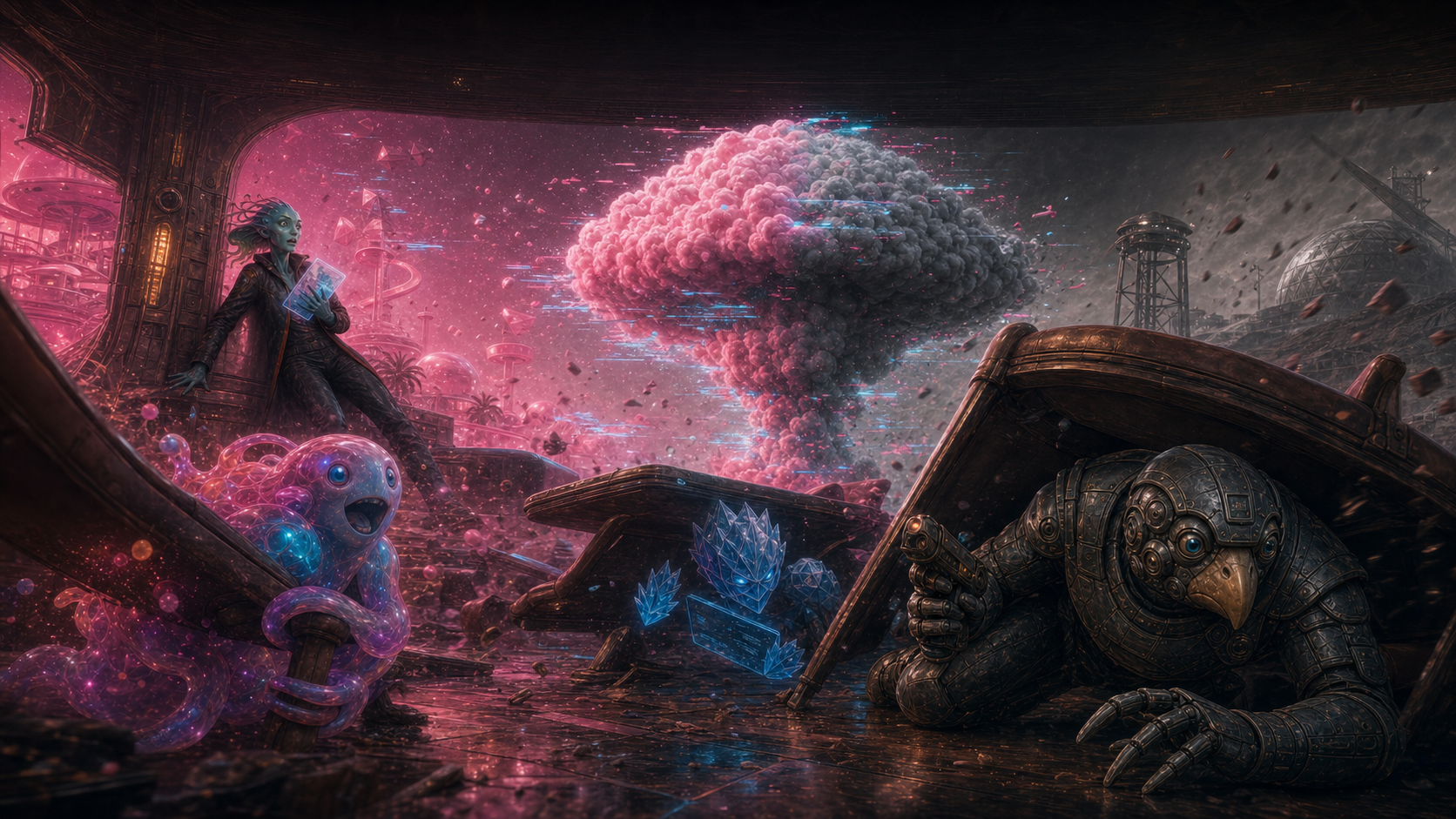
But the projectors, attempting to simultaneously render Barbie with its endless pink sunsets and Oppenheimer with its desert silence, reached the limit of contrast. In the center of the lounge, right between Querr's noir and Kluk's pop-world, space shuddered. The holographic streams collided, mixed, and, contrary to all laws of optics, materialized.
A mushroom appeared.
It was as tall as a two-story building, pulsing, glitching, simultaneously pink and gray, with a disgustingly sweet smell of a vanilla candy bar and a sharp aftertaste of ozone. A distorted mix blasted from the speakers at full volume — the symphonic roar of an atomic blast overlaid with a childish voice that creaked: "...life in plastic, it's fantastic!"
— Cover! — Brax yelled and was the first to dive under a massive chair.
Querr tried to maintain his dignity, but the mushroom emitted a wave that smelled of fear and cotton candy simultaneously, and the crystalline archivist also hid under the furniture. Kluk shrieked with delight, hugging the legs of a chair while his pink glow reflected in the irrational facets of the mushroom.
Tarra froze, her back pressed against the wall, watching as the technology of millennia suffered defeat at the hands of human irony.
The systems rebooted after seventeen seconds that stretched into an eternity. The hologram dissipated with a hiss, leaving behind not heavy radioactive ash, but a sticky pink dust — a leak of cooling gel from the projectors, overheated by the attempt to hold a materialized object in physical space. It settled on scales, crystals, and plastic, harmless but unpleasantly sticky, like the marks of children's fingers on glass.
Tarra sat on the floor, her jacket ruined. She looked at the data summary on her tablet, where the numbers danced a chaotic dance, refusing to form any formula. And suddenly, she laughed. The sound was unexpected, hoarse, almost awkward — she hadn't laughed like that in decades.
Now Tarra understood the error of the experiment. They were looking for a synthesis where humans valued the very proximity of the incompatible. They didn't reconcile the poles, didn't derive a general formula — they simply made room for both. The numbers on the tablet still didn't add up, but for the first time, it seemed not like a measurement failure, but a result.
Querr peeked out from under the chair, and something resembling respect could be read in his facets.
— Defeat, — he stated.
— Yes, — Tarra exhaled, brushing the dust off her hands. — Human irrationality cannot be digitized. It cannot be synthesized. It can only be accepted as a given.
The aftermath analysis began in the lounge. Kluk crawled out from under the table, dusted himself off from the pink powder, and instantly changed his color to a deep indigo. His form became angular, gloomy, cosmic.
— Pink was last week, — he declared with a completely serious expression. — Now cosmic melancholy is in fashion. I feel the vibrations of the void.
Querr silently rose and archived the recording of the glitch, labeling it "Pink Mushroom — a new historical paradox of the 21st century."
Brax, still eyeing the pink dust warily, folded his scanner.
— Too chaotic, — he concluded, and something like relief sounded in his voice. — Too disorderly to be dangerous. Quarantine cancelled.
Tarra sat alone in her office as the station plunged into artificial night. The holo-panel before her flickered with the blue light of a multi-year file. "Report on Humanity's Readiness for First Contact." She opened the "Cultural Anomalies" section and entered the data on "Barbenheimer" — flashing lines about duality, about irrationality, about the celebration of contradiction.
Her fingers hovered over the key.
Status: "Postponed."
Reason: "Insufficient data. Decision not reached."
She closed the file. She sighed heavily. She stretched, turned off the light, and the office plunged into darkness, pierced only by the soft glow of Earth through the viewport — a small, stubborn, illogical world that continued to rotate, turning its contradictions into celebrations. The aliens continued to watch, not understanding, but loving.